Sie befinden sich aktuell in den Alexander Kornbrust Oracle Security Blog Blog-Archiven für den folgenden Tag 20 Apr 2009.
- 11g (12)
- Allgemein (29)
- David Litchfield (7)
- Exploit (23)
- Forensics (7)
- Oracle Security (105)
- passwords (8)
- Repscan (1)
- Security (22)
- Sentrigo (5)
- software (9)
- source code audit (5)
- SQL Injection (24)
- Tools (24)
- Trainings (3)
- Tutorial (2)
- 18 Nov 2011: DOAG 2011 Presentation "Best of Oracle Security 2011"
- 15 Okt 2011: Oracle Critical Patch Update Pre-Release Announcement - October 2011
- 17 Sep 2011: Disable Auditing and running OS commands using oradebug
- 13 Apr 2011: Blackhat Training "HACKING AND SECURING ORACLE (2 days) "
- 2 Apr 2011: Oracle Database 11.2 Express Edition Beta comes with weak default password
- 23 Mrz 2011: McAfee acquires Sentrigo
- 12 Okt 2010: TDE decrypt utilities and TDE/Password flash demo
- 22 Sep 2010: Marcell published "Writing your own password cracker" presentation
- 21 Sep 2010: Laszlo's presentation "Oracle Post Exploitation Techniques" and Marcel's Sybase ASE Password Cracker
- 10 Sep 2010: Update of "Project Lockdown" released
Oracle Security
SQL Injection
- November 2011
- Oktober 2011
- September 2011
- April 2011
- März 2011
- Oktober 2010
- September 2010
- August 2010
- April 2010
- März 2010
- Februar 2010
- Januar 2010
- Dezember 2009
- November 2009
- Oktober 2009
- September 2009
- August 2009
- Juli 2009
- Mai 2009
- April 2009
- März 2009
- Februar 2009
- Januar 2009
- Dezember 2008
- November 2008
- Oktober 2008
- August 2008
- Juli 2008
- Mai 2008
- April 2008
- März 2008
- Februar 2008
- Januar 2008
- Dezember 2007
- November 2007
- Oktober 2007
- September 2007
- August 2007
- Juli 2007
- Juni 2007
- Mai 2007
Archive für 20 Apr 2009
Whitepaper: Penetration from Application down to OS
20 Apr 2009 von Alexander Kornbrust.
Few hours ago I saw that Paul Wright posted an entry on his blog Oracle Forensics about a whitepaper “Penetration from Application down to OS” from Alexandr Polyakov.
Alexandr explains in the well written document how to steal the Windows hashes using a fake SMB Server with low privileges (CONNECT, RESOURCE) via Oracle Text. On a previous blog entry in February “What is more dangerous? ALTER SESSION or OS Access?” I showed how to read files via Oracle Text and Alexandr used a really smart approach to exploit this issue.
Well done Alexandr…
Geschrieben in Allgemein | Drucken | Keine Kommentare »
Pangolin 2.0.2.820 with enhanced Oracle support
20 Apr 2009 von Alexander Kornbrust.
Zwell has posted an entry on Full Disclosure (FD) about a new version of Pangolin. This new version comes with an enhanced Oracle support
[…]
Sometimes we meet Oracle database when we do web sql injection testing. All we do is to dump some data in the db. But you know what? Actually, we can do more and more operation of it, just like:
1. Fast data dumping even cannot use union select
2. Dump server information like : db name, sid, real internet ip address, user list, user hash and so on.
3. Execute PL/SQL
4. Privilege escalation
5. Crack user password
6. Execute system command
7. Install oracle rootkit
8. and so many others
Maybe you could say it cannot execute multi-sql through a single query. Don’t worry. There is a demo at http://down2.nosec.org/swf/pangolin_oracle.html, you can watch it and learn a lot of things about Oracle sql injection.
[…]
Most of the stuff is not new… (at least not for me)
1. Fast data dumping even cannot use union select
==>usage of utl_http to get additional data. A faster way getting all results from multiple queries in a single query is described in a blog entry here.
utl_http is often revoked from public for security reasons. The usage of httpuritype is normally more reliable from the security perspective.
2. Dump server information:
==> via sys_context function. That’s standard Oracle functionality. Nothing special.
3. Execute PL/SQL
==> Pangolin is doing this via an exploit in dbms_export_extension. The bug in dbms_export_extension is old but this exploit was new for me…
4. Privilege escalation
==> I guess they are doing this via the exploit in dbms_export_extension
5. Crack (Oracle database) user password
==> Matrixay is doing this since several years.
6. Execute OS commands
==> several techniques (create table, dbms_scheduler, extproc, java, oracle text, plsql_native_9, plsql_native_10, set_events) are available to do this. Via PL/SQL this is easy to achieve…
7. Install Oracle rootkit
==> yeah. Simple via plsql
Maybe you could say it cannot execute multi-sql through a single query.
==> Stacked queries are not possible in Oracle. Correct me if I’m wrong. You are using a PL/SQL Injection vulnerability in a SQL function. This is a small but important difference.
BTW. :
The current version of Pangolin is using Openssl to crack Oracle passwords but not adding the Openssl license to pangolin. This is a license violation of the OpenSSL license…
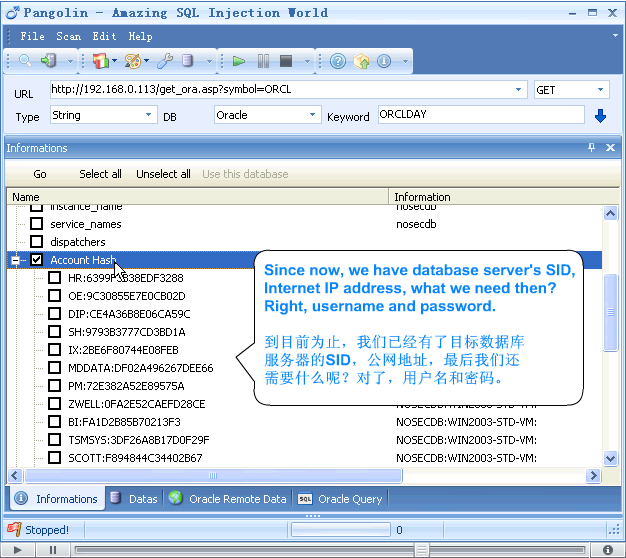
Here is a screen shot of Pangolin 2.0 (taken from the flash movie from the pangolin website):
Geschrieben in Tools, SQL Injection, software | Drucken | 1 Kommentar »