Calendar
Kategorien
- 11g (5)
- Allgemein (15)
- checkpwd (4)
- CPUApril2009 (2)
- CPUJan2009 (3)
- David Litchfield (5)
- Exploit (12)
- Forensics (4)
- Oracle Security (65)
- passwords (5)
- Security (12)
- Sentrigo (5)
- software (6)
- source code audit (3)
- SQL Injection (15)
- Tools (10)
- Trainings (1)
- Tutorial (2)
Letzte Einträge
- 16 Mai 2009: Presentation from Confidence 2009 available
- 1 Mai 2009: Perl - Script to run OS commands via Oracle based Web Apps released
- 23 Apr 2009: SQLMap 0.7 rc is out
- 21 Apr 2009: Listener Exploit (April 2009) from Dennis Yurichev published
- 20 Apr 2009: Whitepaper: Penetration from Application down to OS
- 20 Apr 2009: Pangolin 2.0.2.820 with enhanced Oracle support
- 16 Apr 2009: 3 new Oracle Security Videos
- 16 Apr 2009: SQL Injection Tool Pangolin 2.0 published
- 15 Apr 2009: Oracle Database Scanner Repscan 2.5 trial available
- 14 Apr 2009: Oracle Critical Patch Update April 2009 (CPUApr2009) is out
Links
Oracle Security
Other Blogs
SQL Injection
Trainings
Archive
« Oracle Critical Patch Update Pre-Release Announcement - April 2008 | Oracle Critical Patch Update April 2008 is out »
Looking Glass and Oracle 11g
Yesterday I read an article about Apple Quicktime and LookingGlass. I downloaded the free tool from the website of errata security.
Here are the results from a test with Oracle 11.1.0.6 on Windows. I have scanned the Oracle Home and the tool found 518 Oracle files with dangerous functions like strcpy, sprintf, sscanf, strcat, …
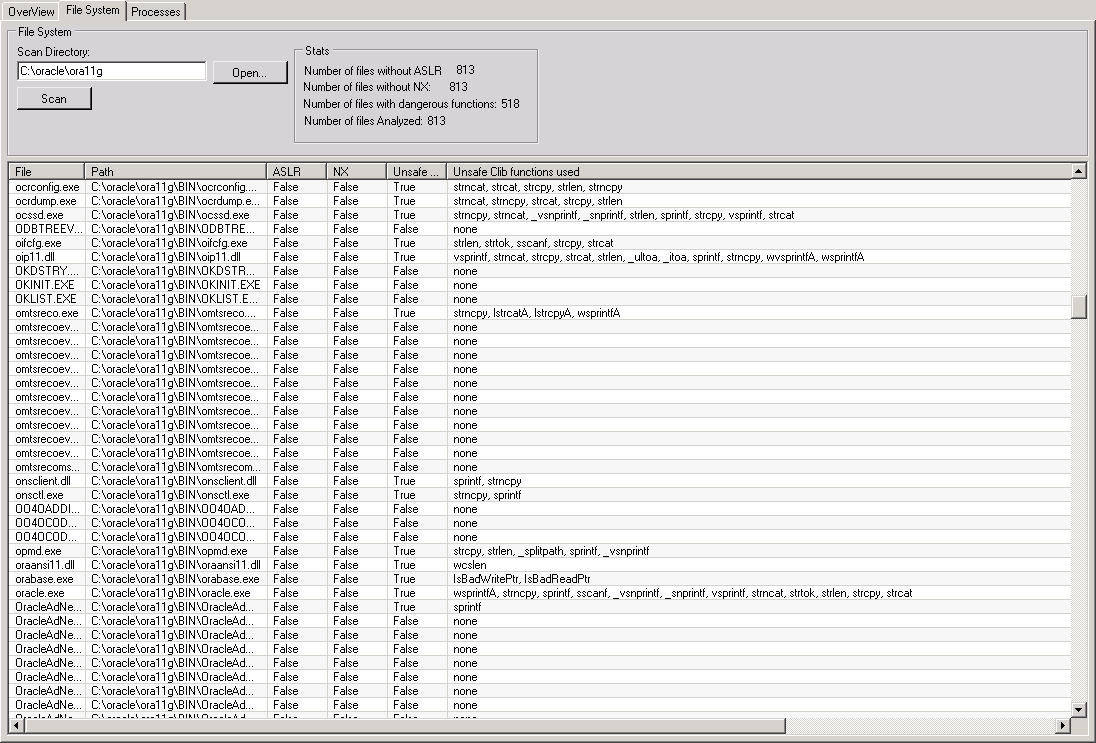
The Oracle executable (oracle.exe) for example is using wsprintfA, strncpy, sprintf, sscanf, _vsnprintf, _snprintf, vprintf, strncat, strtok, strlen, strcpy, strcat.
1 Antwort auf “Looking Glass and Oracle 11g”
Antwort schreiben
Sie müssen als angemeldet sein, um einen Kommentar schreiben zu können.


11 Apr 2008 bei 22:17
Trying to work out the implications of this.
Useful articles are this one which explains what LookingGlass is about.
http://erratasec.blogspot.com/2008/02/unsafe-at-anyspeed.html
and this one about complying with it
http://blogs.msdn.com/david_leblanc/archive/2008/03/14/use-of-aslr-nx-etc.aspx